Showing posts with label immersive journalism. Show all posts

Friday, May 18, 2012

A Closer Look at a Real-Life Form of Immersive Journalism

This week, Nonny de la Pena of the USC Annenberg School of Journalism, joined us in class to discuss some of her latest projects, including Hunger in L.A., which premiered at the Sundance Film Festival, and to teach us a little bit more about the up and coming idea of 'immersive journalism.' As we've noticed the shift to digital journalism, we see more technology related projects popping up in the industry.

While researching more examples of immersive journalism, I stumbled upon Condition ONE.


Condition ONE is an immersive video player for the iPad, which allows users to simulate being in another environment - one that is not quite virtual, that we saw in Nonny de la Pena's work, but rather a world that was captured using real video footage. For example, Condition ONE has video footage depicting soldiers in battle and the Occupy movement protests. Condition ONE is interesting and unique in that unlike other news organizations who specifically formulate their existing news and layouts to fit mobile devices, such as smartphones, iPads, and tablets, this application was built specifically for the iPad, so there's no need to readjust-to-fit, so to speak. Christian Pilling, of Condition ONE, said, "Condition ONE is, instead, new content, which requires a new syntax and grammar. Groundbreaking in technology, Condition ONE has a lot of potential to really simulate other environments for its users. Like Nonny de la Pena's work, a demo of Condition ONE was available at the South by Southwest (SXSW) festival, to an excited and interested audience. 

In comparison to the type of immersive journalism that Nonny de la Pena does with the virtual 'Second Life' type environment and avatars, this type of journalism is a bit more realistic with its real-life footage. However, the 'immersive' part may be lacking in comparison, simply because, as shown in the video above, you can easily see the environment you're standing around as you watch the footage on your iPad screen. It appears to be much less intense, because it's almost as if you're watching a movie instead, but from a cameraman's first person perspective. There are no headsets or gear involved, just you, your iPad, and Condition ONE. There's a lot of progress to be made with this program, but the sheer potential of this type of immersive journalism is overwhelming, and I'm sure we will see many more news stories portrayed in this manner very soon.

Wednesday, May 16, 2012

Revisiting Bin Laden's (Imagined) Assassination

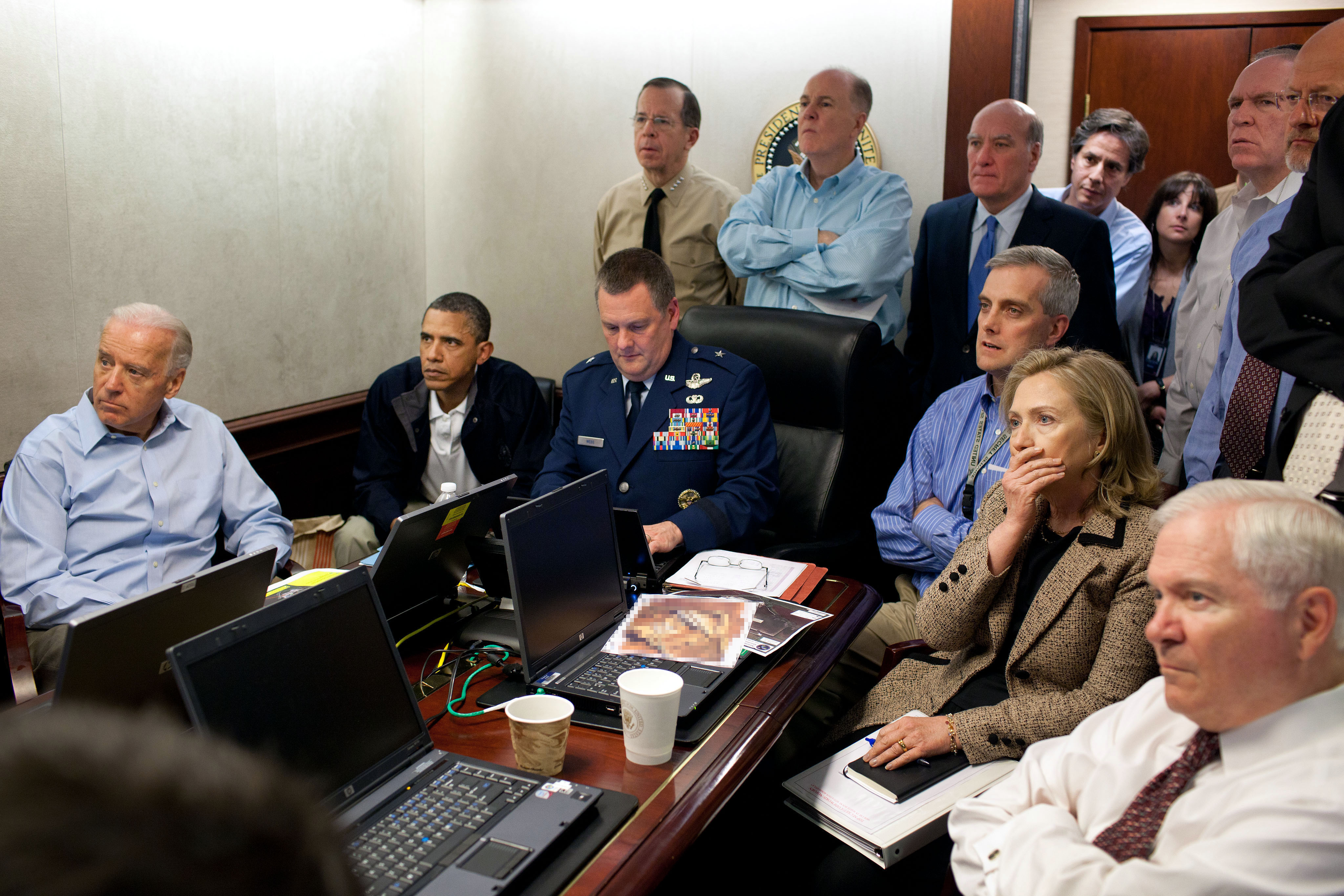
Exactly one year ago, the contemporary world was informed that after ten years of hiding, US Navy SEALs assassinated Osama bin Laden, the individual who claimed responsibility behind the 9/11 attacks. The decade-old event, which forever affected our understanding of security both domestically and internationally, also changed news production and consumption practices. As so, the continuing debate over his actual death, a mission otherwise known as Operation Neptune Spear, and the public's understanding of it was not engaged solely through news articles and press releases, but through broadcast media's incessant pitch for immersive news.

President Obama in the Situation Room, May 2011

Nonny de la Pena, yesterday's featured journalist and professor at the USC Annenberg School of Communication, expanded on these practices through a history of virtuality in news dissemination and civic discourse by concentrating on her past work with virtual news stories.

Using the same software technology, Second Life, which De la Pena described, consider the following YouTube clip on bin Laden's assassination in relation to the nature of virtual news. Given the strict confidentiality prohibiting any media coverage prior and during the event, it is understandable that virtual media was an inevitable choice to attract viewers to tune in to the news. With dynamic scenes, rich audio and music, and crafted storytelling viewers were undoubtedly immersed in the environment of SEAL operation, despite the video description disclaiming, "this is not meant to portray actual events".  Since the public was censored of proof of his death, the next best thing was to recreate it.

The CBS video below more effectively illustrates the event using animated maps, infographics, archived footage, press releases, and most importantly, a simulated reenactment of the operation.


Though the simulation was constructed according to a collection of interviews between soldiers and White House officials, its accuracy can only be contested as much as its purpose as a simulation and not actual footage. The continually digitizing world increasingly demands virtual footage due to content output pressures, however its usefulness and accuracy must be negotiated between both journalists and viewers.

Does Immersive Journalism have a future?

Nonny de la Pena, has been the pioneer of immersive journalism, an alternative form of reporting that allows participants to deeply engage in a news story by being part of it through a virtual world. Nonny de la Pena has combined the conventions of news gaming and documentaries to create a virtual world in which participants are able to truly engage and be emotionally connected to the news story.Immersive journalism allows participants to truly hear, see, and feel the news event. Immersive journalism sounds like a promising tool for journalism and perhaps could be the very future of journalism. It is a powerful tool that really engages it's audience through a compelling environment and can be use to help promote social change or raise awareness on certain controversial issues.So far Nonny  de la Pena has used immersive journalism to advocate for human right issues. A genre that doesn't get covered enough due to the difficulty of communicating and engaging the reader in a genuine manner that truly moves the reader.
  Journalist seek to convey messages that impact their readers and influence them to be active citizens. Immersive  journalism offers a world in which that can be done by triggering emotions and allowing the participants to learn more about the content and detail of the story. People come to understand and care about certain issue when they are directly connected or emotionally affected to an issue. Therefore, immersive journalism offers great opportunities for journalist who seek to provoke change within their readers and whom are working to make  visible certain issues, communities  and people that are often rendered invisible by mainstream media.

  Nonny de la Pena's work is a powerful example that shows how she is combining technology and journalism in innovative ways to promote social change. Her work provides  a form of representation for those who have been politically, socially, or economically excluded.  Her work does not only provide a vivid reality of certain issues but it also allows the participant to have agency in the context he or she is put in by allowing the reader to move around and interact with other avatars.This form of interaction is symbolic of the agency people have and the importance of understanding certain issues in which  citizens can help change.